The Complete Welcome Flow Guide for DTC Brands
Build a consent-aware welcome email and SMS journey with a clear starting configuration, exits, measurement plan, and a visual Klaviyo flow map.
- Build the trigger, timing, branches, and exits for this flow
- Measure and improve the flow against a stable cohort
No prior lesson required.
What is a welcome flow, and why does it matter?
A welcome flow is a consent-aware email series that turns a new subscriber's stated interest into a useful first purchase decision. It is usually one of the first lifecycle automations we build because eligibility is clear and the subscriber has just raised their hand, not because it carries a universal revenue promise.
The ZHS baseline is a five-message email journey with an explicit purchase exit, a clear first-purchase decision, and a separately consented SMS path where it is appropriate. Treat the map below as a starting configuration to test against your acquisition promise, margins, product consideration cycle, and support capacity, not as a universal timing or performance benchmark.
What a credible welcome flow has to do
- 01Confirm eligibility
Send only to the specific channel and consent state the person is eligible to receive.
- 02Make one useful next step clear
Lead with the product, offer, or education that matches the promise that earned the signup.
- 03Route or stop
Exit purchasers into post-purchase education and stop when consent or relevance ends.
ZHS operating sequence. This is a design and governance model, not a chart of universal performance results.
What emails go in a welcome series?
The visual flow below is the ZHS starting configuration for a DTC brand with a clear first-purchase offer: a hook and offer, bestsellers, brand story, proof, and a final decision message. It is a five-message default, not a requirement for every brand. Shorten it for a fast, low-consideration purchase; add education when a product needs it; and only use a deadline when it is true.
Before building, match the sequence to the promise that captured the signup. Someone who joined for a quiz result, back-in-stock alert, or educational guide should not receive a generic discount sequence as though they joined the newsletter.
Here is what this looks like in practice.

Build assumptions & sources
- ZHS starting configuration. Review timing, offer, overlap, re-entry, and attribution against the active program before publishing.
View full build
Read the text version
Trigger: When someone joins the newsletter list
Entry filters: Can receive email marketing
Exit conditions: Placed Order since entering; Unsubscribed or otherwise cannot receive email
Re-entry: Allow re-entry
- Conditional split: Placed an order with the welcome code before
- Yes · Already used the code
- email: Email 1AWelcome back, what to try next
- No · New subscriber
- email: Email 1BYour welcome offer, code in first fold
- Yes · Already used the code
- delay: Wait 8 hours
- email: Email 1B resendResend to anyone who did not open it
- delay: Wait 16 hours
- email: Email 2Bestsellers highlight
- delay: Wait 1 day
- email: Email 3Brand and founder story
- delay: Wait 2 days
- email: Email 4Social proof
- delay: Wait 2 days
- email: Email 5Last chance, us vs competitors
How it is built in Klaviyo
The map is an explicit ZHS baseline: it starts when a person joins the newsletter list and exits people who purchase or can no longer receive email. The first split distinguishes a person who already used the welcome code from a new subscriber, so the message can point to the right next action rather than repeat an irrelevant offer.
The current baseline uses a short first resend window followed by progressively longer waits. Those settings are intentionally visible in the flow map so a team can review them, but they are not a blanket cadence recommendation. Confirm overlap with campaigns and abandonment flows, Smart Sending behavior, sending reputation, promotion dates, and the product's decision cycle before activation.
Choose the offer from contribution margin, repeat-purchase potential, acquisition promise, and the behavior you want to create. A discount is not mandatory: product education, a bundle, a sample, or free shipping can be the right first-purchase nudge. Write the offer into the test plan so the team can compare it against a true control rather than changing cadence, creative, and economics at once.
For a non-opener resend, change the subject line or framing, exclude people who purchased or opted out, and measure incremental orders against a comparable cohort. A resend can help a specific audience; it is not automatically incremental or appropriate for every sender.
Only use urgency if it's real. Fake scarcity damages trust. If your discount doesn't actually expire, don't say it does.
Should you keep emailing people after they buy?
No. The moment someone buys from the welcome flow, stop sending them the sales emails and move them into your post-purchase flow. Split the sequence into two paths: a non-purchaser path that keeps selling, and a purchaser path that shifts to product education and cross-sell.
- Continue Emails 2-5 as outlined
- Conversion-focused messaging
- Include discount reminders
- Move to post-purchase flow
- Product education & satisfaction
- Cross-sell later
Should you run SMS with your welcome flow?
Run SMS as a separate, specifically consented path, not as an automatic copy of the email journey. It sits alongside the other SMS flows every brand should run, with its own consent, frequency, timing, and compliance review.
Build assumptions & sources
- ZHS starting configuration. Never use a generic quiet-hours override; verify consent, recipient location, account configuration, and current platform/legal requirements before activation.
View full build
Read the text version
Trigger: When someone joins the SMS list
Entry filters: Can receive SMS marketing
Exit conditions: Placed Order since entering; Revoked SMS consent or otherwise cannot receive SMS
- Conditional split: Placed an order with the welcome code before
- Yes · Already used the code
- sms: SMS 1AWelcome back, what to try next
- delay: Wait to match the email flow
- sms: SMS 2ABestsellers, what is new
- No · New subscriber
- sms: SMS 1BYour welcome offer
- delay: Wait to match the email flow
- sms: SMS 2BBestsellers, real deadline if applicable
- Yes · Already used the code
| Message | Timing rule | Content |
|---|---|---|
| Initial SMS | Only when consent and applicable send-time policy permit it | Welcome and the promised next step |
| Follow-up SMS | Align to a meaningful email-flow moment, if it remains relevant | Product proof, bestsellers, or a real offer deadline |
Do not rely on a fixed calendar rule just because it appears in a template. If a second message is appropriate, align it to the current email flow and offer state, and exit anyone who purchased or withdrew consent.
Do not treat quiet-hours overrides as a generic welcome-flow tactic. Confirm the recipient's consent, location, account configuration, current platform behavior, and applicable rules before deciding whether or when to send; the official sources above should be checked again when the program is launched or materially changed.
Welcome to [Brand]. Here is your 10% off: [CODE]. Shop now: [link]
If the offer has a real deadline: Your 10% off expires tomorrow. Shop here: [link]
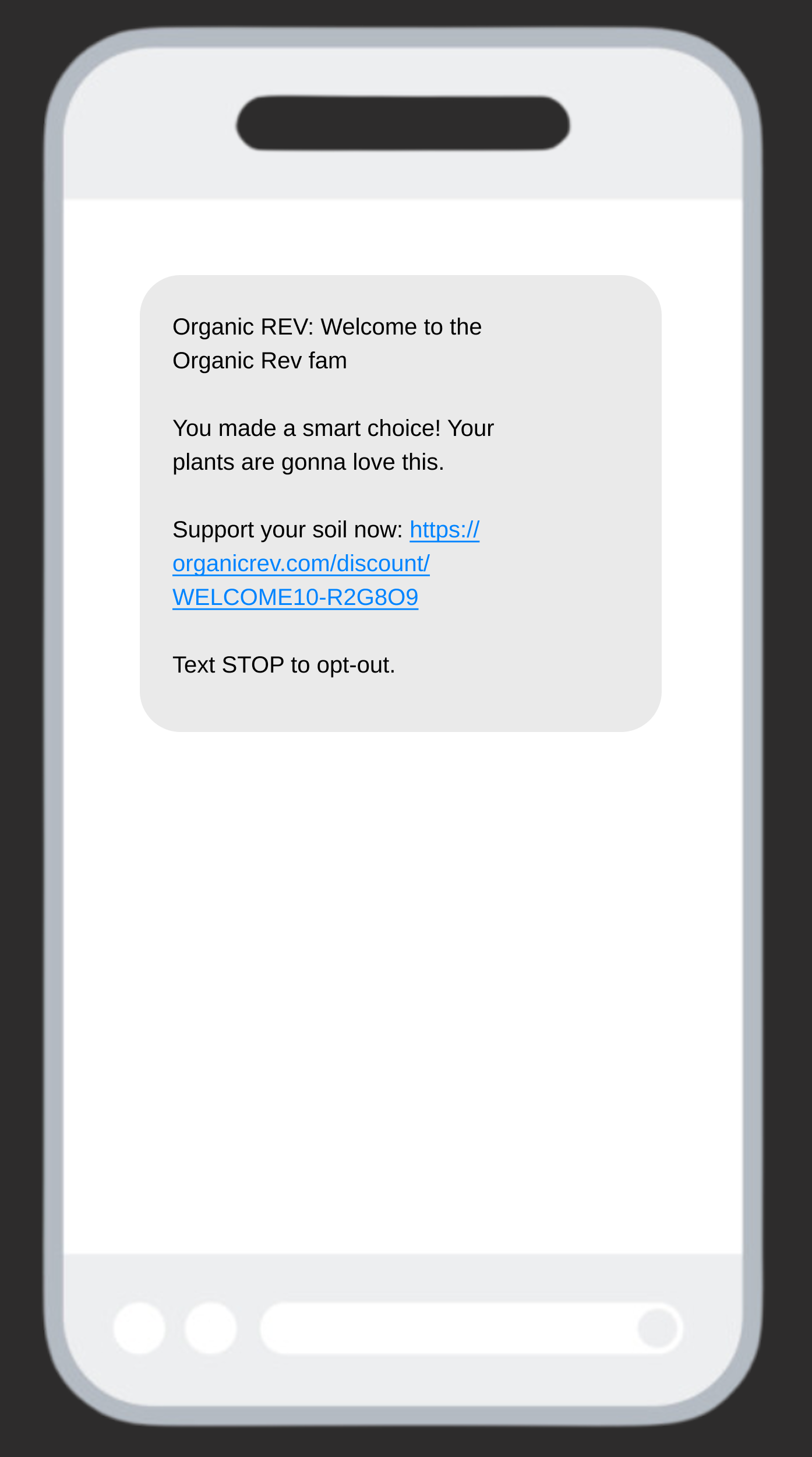
Keep SMS short and direct. Save the storytelling for email.
How should you evaluate welcome flow performance?
Review the complete welcome sequence over a stated period. Start with total attributed revenue, eligible entries, first-purchase rate, and downstream customer behavior. Then inspect delivery, clicks, unsubscribes, complaints, and the acquisition source behind each cohort. This is not an industry promise, a causal-lift estimate, or a substitute for checking the active attribution definition.
| Measure | Keep the definition stable | Use it to decide |
|---|---|---|
| Eligible entries | Count only people who could receive the selected channel | Whether list quality or consent is changing the denominator |
| First-purchase rate | Keep the conversion window and offer treatment consistent | Whether the sequence is helping a new subscriber take the next step |
| Total attributed revenue | Use the same date range, attribution window, and eligible-entry definition | Whether the full sequence contributes more value over time |
| Unsubscribes and complaints | Compare trend by acquisition source, message, and offer | Whether the flow creates attention at the cost of trust |
If the flow underperforms, inspect the acquisition promise, subject line and deliverability, offer relevance, landing-page continuity, and cohort definition before adding more messages.
What are the most common welcome flow mistakes?
Most welcome flows fail for the same operational reasons. Fix these first.
-
Using a generic sequence for every signup source. The promise behind the signup should shape the first message.
-
Changing everything at once. Test the resend, offer, cadence, or creative with a defined cohort instead of declaring a universal win.
-
No clear CTA. One email, one primary CTA. Make it obvious.
-
Ignoring the mobile experience. Review the email, landing page, and code redemption path on a real mobile device before launch.
-
No exit or suppression logic. Purchasers, unsubscribed profiles, and ineligible channels should leave the sales path promptly.
Technical Checklist
- Flow starts immediately on list signup
- Exit criteria: Purchase or unsubscribe
- Documented waits with an owner and a reason for each
- Different paths for purchasers vs. non-purchasers
- UTM parameters for tracking
- Mobile tested
- All links verified
Get Expert Help
We build complete welcome flows for DTC brands as part of our retention packages: strategy, copywriting, design, platform configuration, measurement, and QA.
Our team handles the build end to end, then documents the baseline so your internal team can keep it accurate as the program changes.
Six roles to study
These are individual reference emails, not one original sequence. Study the role each email can play, then build the order, offer, and timing for your own audience.
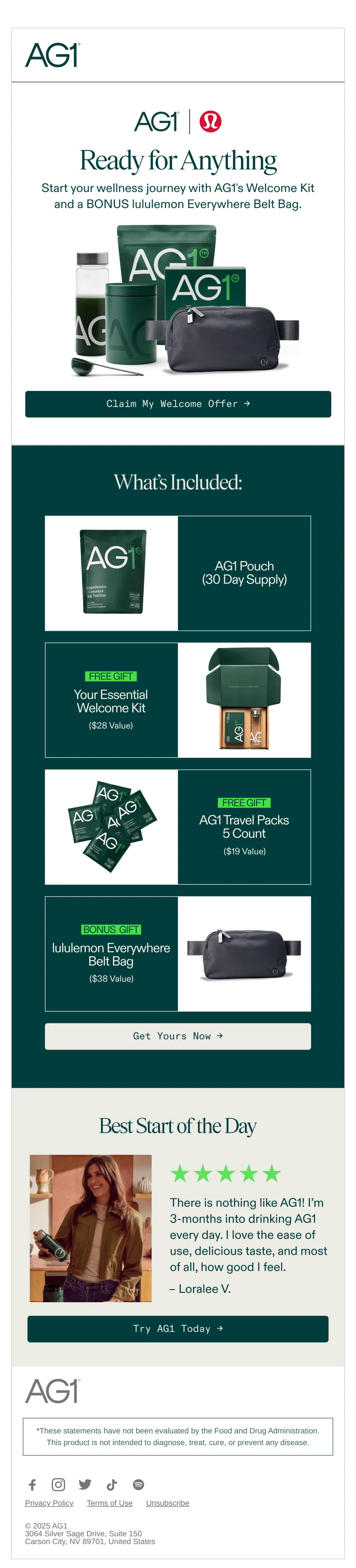
Get a BONUS lululemon Bag with subscription
Pattern: AG1 x lululemon collab bundle as welcome offer.
Use it here: Use an immediate benefit to make the first decision clear. Keep the signup promise, eligibility, and offer terms truthful for your own list.
Open reference in new tab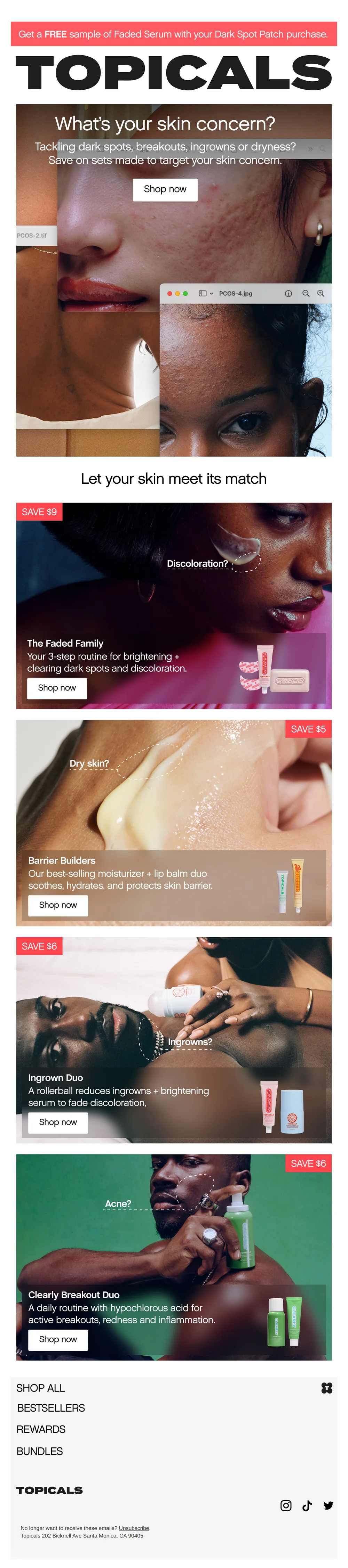
Don’t know where to start?
Pattern: Match products to your specific skin concern.
Use it here: Help a new subscriber find the product or path that fits their stated need instead of presenting every product as equally relevant.
Open reference in new tab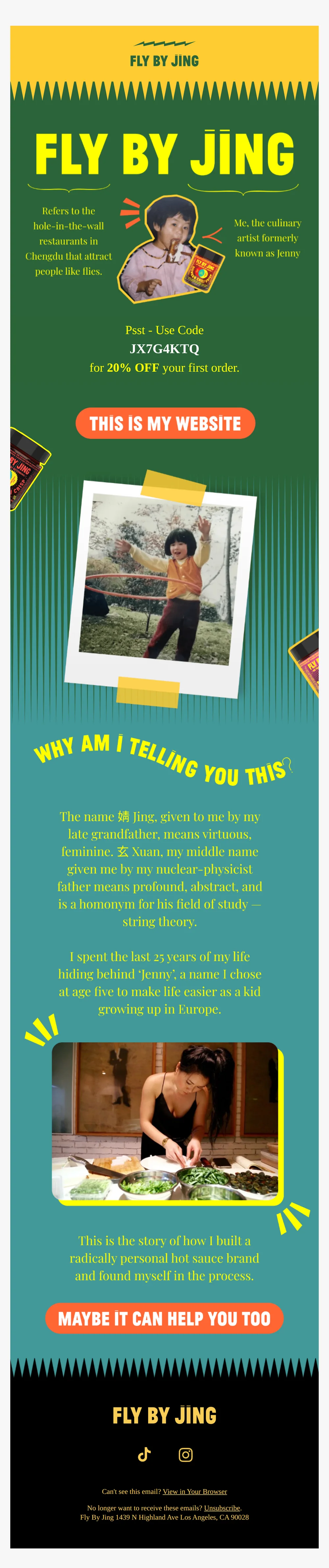
Why it's Fly By - and who is Jing?
Pattern: founder's childhood photos explain the brand name.
Use it here: An origin detail can make the sequence feel human before it asks for a first purchase. Keep the story specific to the brand and signup promise.
Open reference in new tab
Pop Quiz: Is Your Protein Bar Actually Good? 🧪
Pattern: quiz-style test helps you choose smarter protein bar.
Use it here: Use a useful question to teach the buying decision. The education should reduce uncertainty, not delay the next step without a reason.
Open reference in new tab
Industry Standard vs. Momentous Standard
Pattern: Arnold Schwarzenegger trusts only one supplement brand.
Use it here: Show credible proof that answers a shopper concern. Use claims, reviews, and endorsements your own brand can substantiate.
Open reference in new tab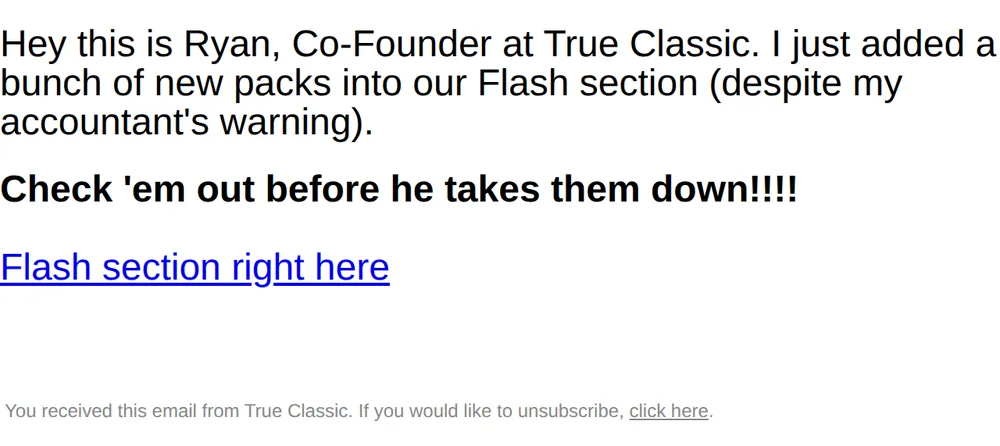
Please don’t tell my finance team
Pattern: Founder added deals despite accountant's warning.
Use it here: A direct final reminder can work when it has a real reason to send. Do not borrow urgency, deadlines, or a persona your brand cannot support.
Open reference in new tabCreative and design curation only. These are role references, not reported revenue, conversion, or a promise that the exact tactic will transfer unchanged.
Need help implementing this?
We build and manage complete email & SMS programs for DTC brands. Get a custom plan for your brand.
Get Your Free Audit + Gameplan